The Central Swiss Pass Trinity
When central European transport corridors were engineered across the Alps in the late nineteenth and early twentieth centuries, road construction focused on connectivity between the cantons of Valais, Bern, and Uri. Today, the loop formed by the Furka Pass (2,429m), Grimsel Pass (2,164m), and Susten Pass (2,224m) represents one of the greatest concentrations of continuous high-alpine asphalt engineering anywhere in the world.
Traversing these passes offers an intense study of vertical transition zones. Within thirty minutes of driving, travelers move from fertile river valleys populated by dense fir forests into austere, treeless zones of glaciated granite bedrock, hydro-electric retention reservoirs, and permanent snow patches.
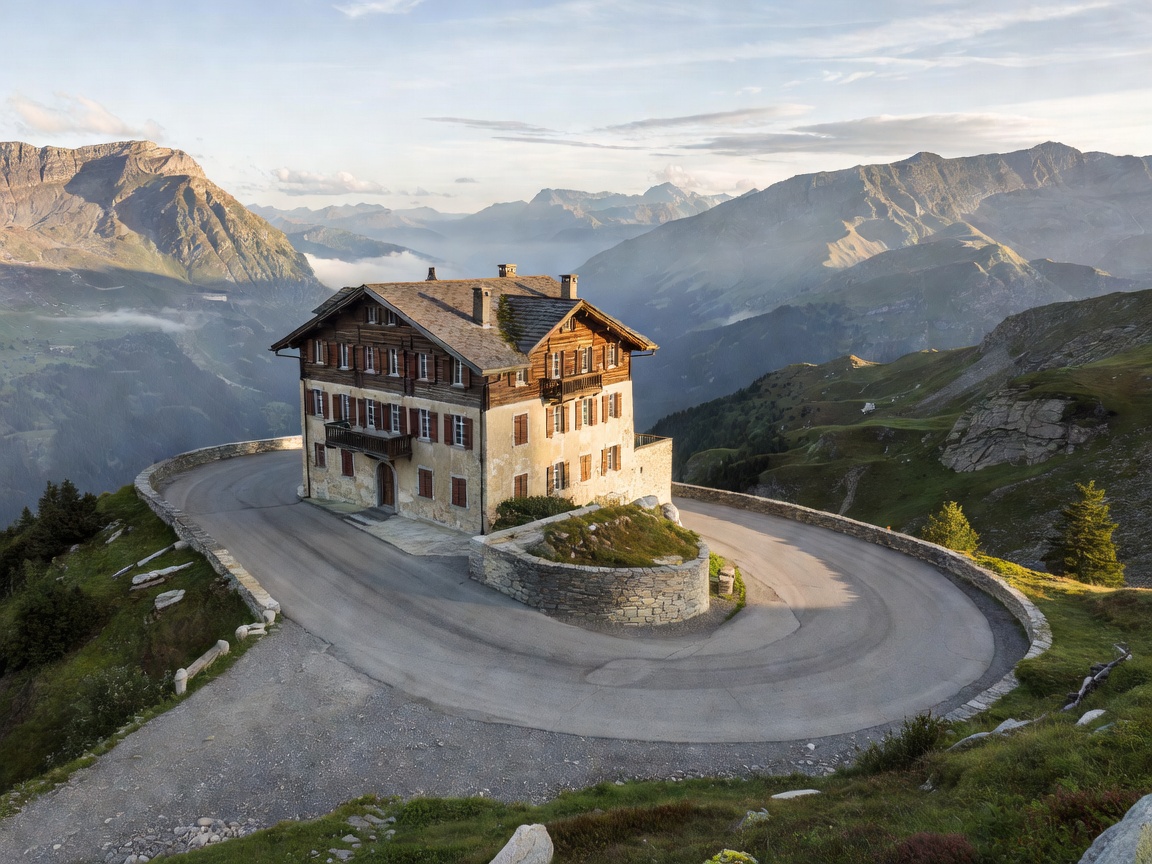
Furka Pass: Granite Spines & The Rhône Ice Grotto
Connecting Gletsch in the canton of Valais with Realp in the canton of Uri, the Furka Pass reaches an apex elevation of 2,429 metres. The road's western ascent delivers direct, unencumbered side-views of the receding Rhône Glacier (Rhonegletscher). The famous roadside Hotel Belvédère, constructed in 1882 on a hairpin corner, stands as an architectural emblem of early Swiss grand tourism.
From the Belvédère pullout, travelers access the pedestrian ice tunnel carved directly into the glacier body every spring. Geographically, Furka forms the continental divide between the Mediterranean drainage basin (via the Rhône River) and the North Sea basin (via the Reuss and Rhine Rivers). The descent toward Realp features narrow, stone-walled sections that demand meticulous gear braking and passing etiquette.
Grimsel Pass: Hydroelectric Basins & Granite Monoliths
Crossing north from Gletsch into the Haslital in the Bernese Oberland, the Grimsel Pass presents a stark contrast to Furka’s crumbly slate ridges. Grimsel is dominated by immense slabs of polished granite and artificial glacial reservoirs—such as the Grimselsee and Räterichsbodensee—engineered by Kraftwerke Oberhasli (KWO) to harness alpine hydroelectricity.
The viewing pullouts along the Grimsel summit terrace reveal the Grimsel Hospiz, an austere stone manor resting on a rocky peninsula between two turquoise-grey glacial reservoirs. The pass is distinguished by broad sweepers, substantial modern tarmac resurfacing, and dramatic lateral views into the Unteraar glacier basin.
Susten Pass: The Apex of Scenic Road Engineering
Completed between 1938 and 1945, the Susten Pass (linking Innertkirchen with Wassen) was engineered from the outset specifically for panoramic scenic transit rather than purely commercial freight. Unlike older carriage paths widened under duress, Susten was carved with wide curves, reinforced stone viaducts, and scenic viewing terraces integrated into the retaining masonry.
The western ramp through the Gadmental offers direct side-views of the Steingletscher, a dramatic glacier tongue spilling down from the Sustenhorn (3,503m). At the 2,224-metre crest, a 325-metre crest tunnel connects the Bernese watershed to the rugged Meiental of Uri, providing a startling transition between microclimatic zones.
Seasonal Accessibility and Operational Windows
Due to intense winter precipitation, these passes are closed under seasonal winter blockades (Wintersperre) for approximately seven months each year. Opening dates depend directly on cantonal snow-plowing operations using rotary blowers to clear snowpacks that regularly exceed ten metres in avalanche gullies.
- Opening Window: Typically late May to mid-June, depending on spring thermal averages.
- Closing Window: First major autumn snowfall, typically occurring between mid-October and early November.
- Timing Advice: Morning travel (between 07:30 and 10:00) avoids peak tourist coaches and aggressive sport cycling groups, ensuring unimpeded access to scenic turnouts.