The Waterborne Perspective of Central Switzerland
Unlike regular glacial lakes with straightforward elliptical shorelines, Lake Lucerne bends through complex basins shaped by river valleys and glacial scouring. Traversing the lake on one of the five historic paddle steamers operated by SGV (Schifffahrtsgesellschaft des Vierwaldstättersees)—some dating back to the early 1900s—delivers an intimate side-view perspective of sheer cliffs plunging straight into deep alpine water.
From the water, the mountain profiles of the Rigi massif, the Bürgenstock ridge, and the serrated crest of Mount Pilatus form an ever-shifting framing device. The passage through the "Nasen" (the narrow strait between the Vitznau basin and the Gersau basin) mimics Norwegian fiord landscapes with rocky headlands rising dramatically on both sides of the vessel.
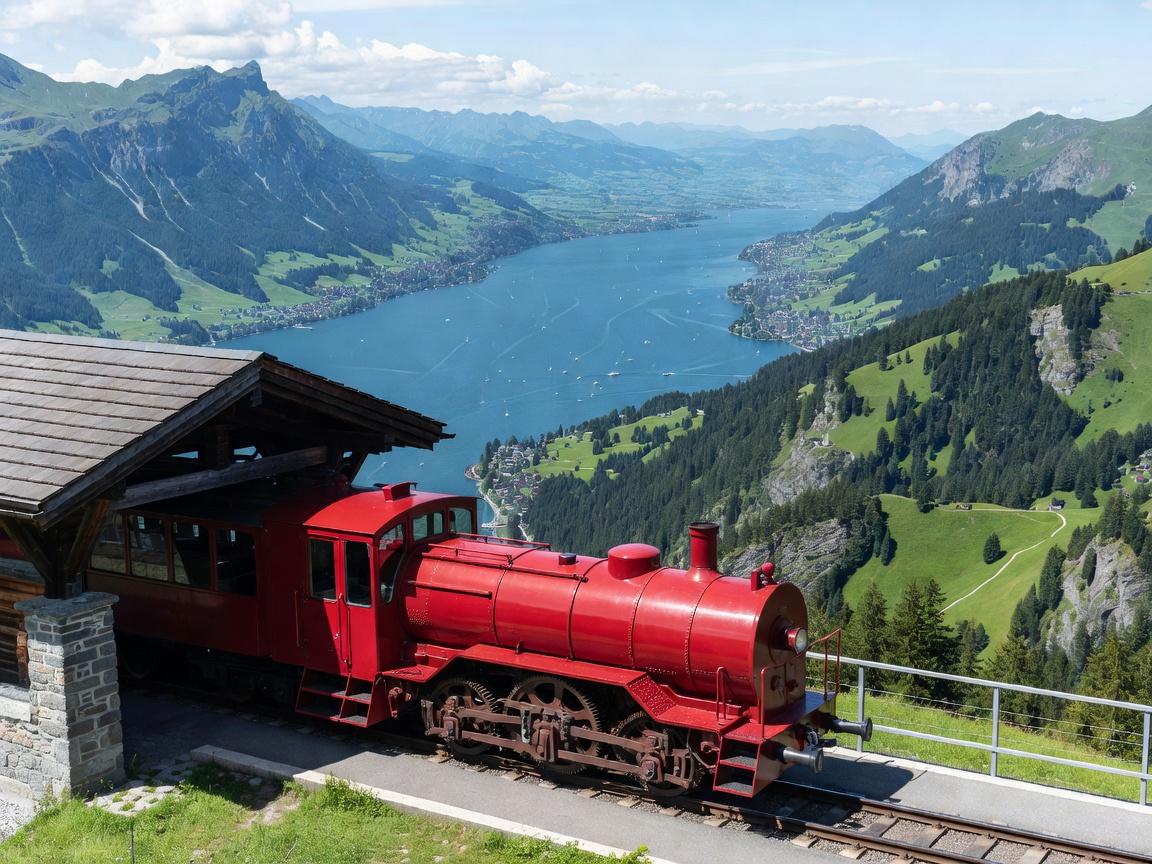
Mount Rigi: Europe's Oldest Mountain Railway
In 1871, Swiss engineer Niklaus Riggenbach built continental Europe's first cogwheel mountain railway from Vitznau up to Rigi Staffel, subsequently extended to Rigi Kulm (1,797m). Operating with a ladder-type rack system, the train climbs along the south-facing slopes of Mount Rigi, providing expansive views of the lake surface 1,300 metres below.
Because Mount Rigi stands as an isolated pre-alpine massif at the northern edge of the Alps, the summit panorama at Rigi Kulm offers a 360-degree dichotomy: to the north lies the rolling Swiss Plateau (Mittelland) extending toward the Black Forest, while to the south rises the jagged, ice-capped wall of the Glarus and Bernese Alps.
Mount Pilatus: The World's Steepest Rack Railway
Directly across the lake from Rigi stands Mount Pilatus (2,132m). Engineered in 1889 by Eduard Locher, the Pilatusbahn connects Alpnachstad with Pilatus Kulm using an ingenious horizontal rack system (the Locher rack), engineered specifically to eliminate the risk of the cog wheels climbing out of the teeth on extreme gradients.
With a maximum gradient of 48 percent, the carriages are built in stepped tiers. The track crawls through sheer rock walls, alpine meadows, and four tunnels blasted out of solid limestone. The lateral view across Lake Lucerne’s intricate arms during the final ascent through the Esel rock face represents one of Switzerland's most dramatic vantage points.
Comparative Routing: The "Golden Round Trip"
To experience the complete synergy of water, rack rail, and aerial cable systems, the traditional Golden Round Trip (Goldene Rundfahrt) serves as the primary benchmark:
- Transit Segment 1: Historic paddle steamer from Lucerne pier 2 across the lake to Alpnachstad (approx. 50 to 70 minutes).
- Transit Segment 2: Ascent on the 48% Locher rack railway to Pilatus Kulm.
- Transit Segment 3: Descent down the northern cliff face via the "Dragon Ride" high-capacity aerial cableway to Fräkmüntegg and Kriens.
- Transit Segment 4: Trolleybus link back to Lucerne central train station.